

New week, new post! Moving on through the book, this week’s post is going to be about chapter 7 of Defy – Ideology. Let’s get to it!
How did the Nazis feel about Religion?
As mentioned in the first paragraphs of the book, the Nazis did not look favorably upon religion. Basically, Nazis believed that they were the true religion. They combined both state and religion to make their government. There was to be no one higher up than Hitler.
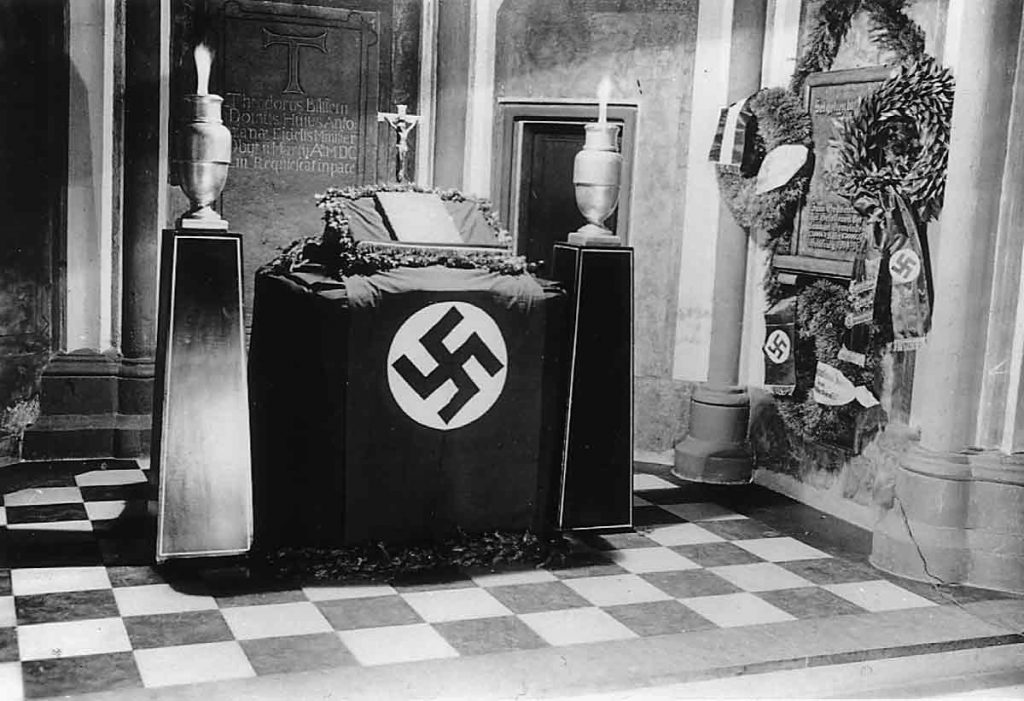
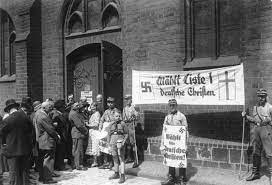
This obviously was highly controversial. It was also very conflicting for many. This also led to many of the reasons behind the Holocaust, but for now, I’ll focus on the persecution of Christians.
Knowing that around 90% of Germany during WW2 was Christian, Hilter claimed that the Nazi party was a Christian movement. However, within the Nazi ranks, there were people who held anti-church and anti-Christian views, in addition to anti-semitism. They hated Christianity and wanted there to be little to no religions that opposed their ideals to be in Germany.
The Nazis tried to establish the National Reich Church to encompass all of Germany. They wanted to take over all the Churches, stop the distribution and printing of the Bible, clear away all Crucifixes, pictures of saints, and Bibles, and also only use Mein Kampf as the only book on their altars.
Eventually, the Church failed to take hold of the country and the Nazis lost interest in this idea. However, it is clearly evident from their intentions that Nazi leaders meant to replace all religions with Nazism.
What did they do to Christians?
Still, while the Nazis were unable to enact the full extent of their church, there were many actions taken against Christians. Over 6,000 clergymen were charged with treason and were imprisoned or executed. Assets of Churches were taken, religious institutes were closed, and many nuns and monks were expelled from monasteries/convents. The Nazis forced the monks and nuns to either be deported or renounce their vows.
In Poland, the Nazi’s cruelty was far worse. There, they targeted the Catholic Church the most. During WW2, the Nazis murdered an estimated 3,000 members of the Polish clergy. Many of the clergymen died in concentration camps. Churches were closed and most priests were imprisoned or deported. Today, many of those who died are considered Martyrs in the Catholic Church.
How did the Catholics respond?
Well, that is very complicated. At first, the Vatican made an agreement with the Nazi party to stay out of Germany’s politics. However, the Vatican continued to denounce the Nazi party. Many Catholics denounced openly the Nazi party, but oftentimes were imprisoned or sent to concentration camps.
Eventually, the Nazis continued to place more and more sanctions on the Church. They also closed more and more churches, monasteries, convents, schools, etc.
WW2 under the Nazis’ rule was not a good place to live if you were Christian or even remotely religious.
Annabelle’s Confession
It is often said that talking about your problems can relieve your stress and clear your conscience. For Catholics, the sacrament of confession, in plain terms, is much like that. The sacrament, though God, washes you from the sins you confess to the priest.
Now, even though Annabelle isn’t technically a Nazi and though she doesn’t actually believe in the Nazi’s actions, she still feels guilty. Annabelle believes it is wrong for her to use her paper as a medium for Nazi propaganda. It’s a tough moral dilemma.
Abbé Bernard Bouveresse’s Response
Abbé Bernard Bouveresse, the priest for Basilica Sainte-Clotilde in the book, offers Annabelle some comfort. He makes her know that what she is doing is not bad – she’s helping people. True, in order to help others, she must do some things she does not agree with. However, this all balances out with Annabelle’s good intent to help the Allies win the war. Abbé absolves her of her sins and encourages her to keep fighting for freedom.
This week’s post has mostly been in-depth about Nazi ideology, which is the true main focus of this chapter. Much of what happens is very straightforward, so I decided to keep my focus mostly upon the historical details in order to enrich the reading experience.
What was your favorite part of the chapter? Was there something not discussed above that you would like me to touch on?
Comment below your questions and/or reactions!
Till next time!
L.A.
P.S. – If you want a reminder about who Abbé Bernard Bouveresse is, refer back to About Defy (Part 2)!